Two lineages: coarse graining of field–material coupling since 2016, soft-composite design and adhesion since 2025
Field-responsive materials turn a remote stimulus into deformation, force,
stiffness change or contact. The mechanisms are coupled: particle fraction
alters stiffness and field coupling, finite deformation changes geometry,
internal interfaces transfer load but may slip or debond, and external contacts
concentrate or release energy.
This thrust has two lineages, and they meet at the same question. The older one
is electrostatics and coarse graining: how a field couples to a material’s
microstructure in the first place, and what survives when you pass from a
discrete description to a continuum one. That runs from a thesis on coarse
graining electric-field interactions with materials, through discrete-to-continuum
limits of long-range electrical interactions, to a two-scale continuum limit for
nonlocal electrostatics in random media. The newer one is design: taking a
material whose response to a field is understood and deciding where to put
material and magnetization so a structure does something useful.
The first lineage supplies the mechanism the second one designs against. The
design calculations depend on which microscale interactions and fluctuations are
retained in the effective material description. Omitting a consequential
contribution can change the constitutive response the optimization is based on.
The scientific question. How do microstructure, interfaces, geometry and
applied fields determine actuation, degradation and adhesion, and how can
these mechanisms be composed into functional material–structure systems?
With Ian Galloway the group built 21 constitutive models, seven effective
shear-modulus relations against three strain-energy functions, and compared them
on actuation problems. Across those problems the strain-energy form changed the
predicted deformation relatively little; the shear-modulus relation changed it a
great deal wherever magnetic material overlapped a highly deforming region.
Experimental stress–strain data then selected the relation to carry forward, and
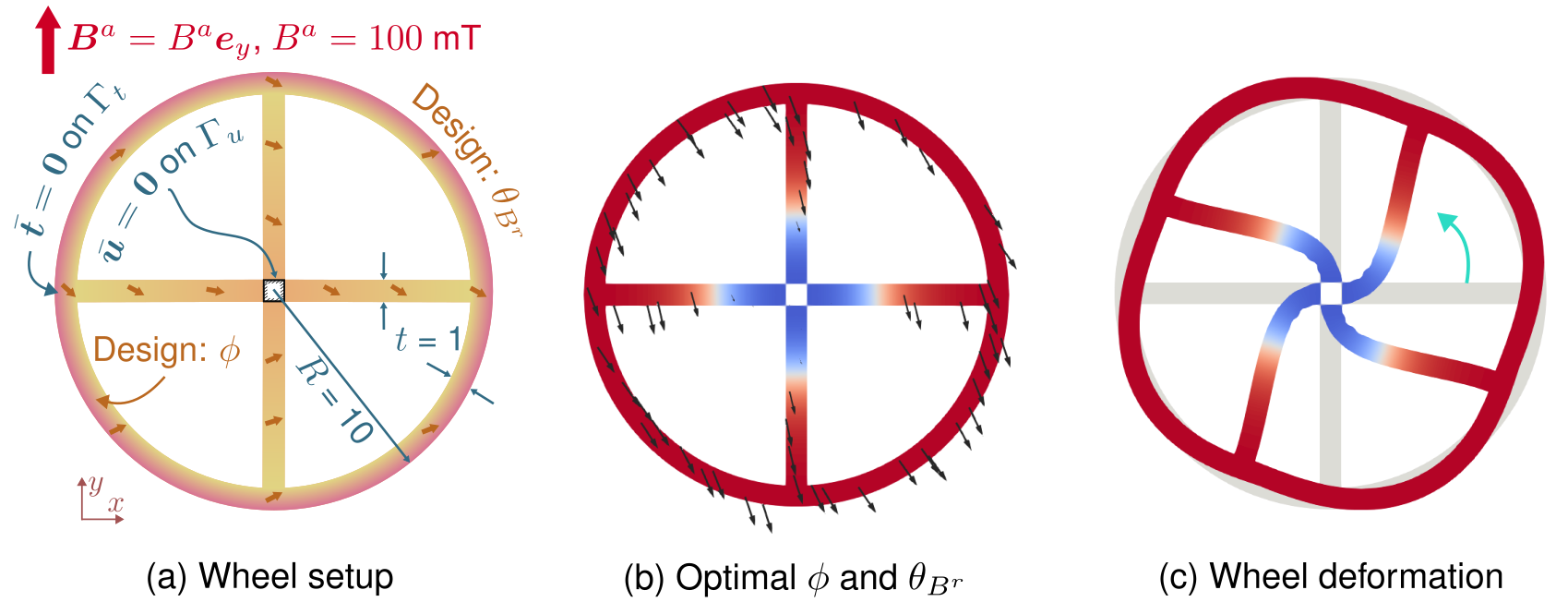
only after that came the joint optimization of structural density, particle
fraction and remanent-magnetization direction. That ordering is the point: a design
produced on top of an unexamined material description is an illustration, not a
design.
That formulation turned out not to be specific to hard-magnetic materials.
What the optimization needs from a material is a free-energy density and a
declaration of which design fields it uses; given those, the state solve, the
adjoint sensitivities and the optimizer are unchanged. MatTO is built along that
seam, and eleven examples spanning hard-magnetic soft materials, liquid crystal
elastomers, and anisotropic and isotropic magneto-active elastomers in two and
three dimensions exercise it across material classes where the design fields
stand for different physical quantities.
The longer-range design target is a sequence: engage, carry load, tolerate
defects, change shape or position, and release, rather than one peak response.
Reaching it means varying material distribution, topology, interface geometry
and field history together, and judging the result against geometry-only,
material-only and sequential baselines.