Home Publications · CMAME
Residual-based error corrector operator to enhance accuracy and reliability of neural operator surrogates of nonlinear variational boundary-value problems
Why it matters
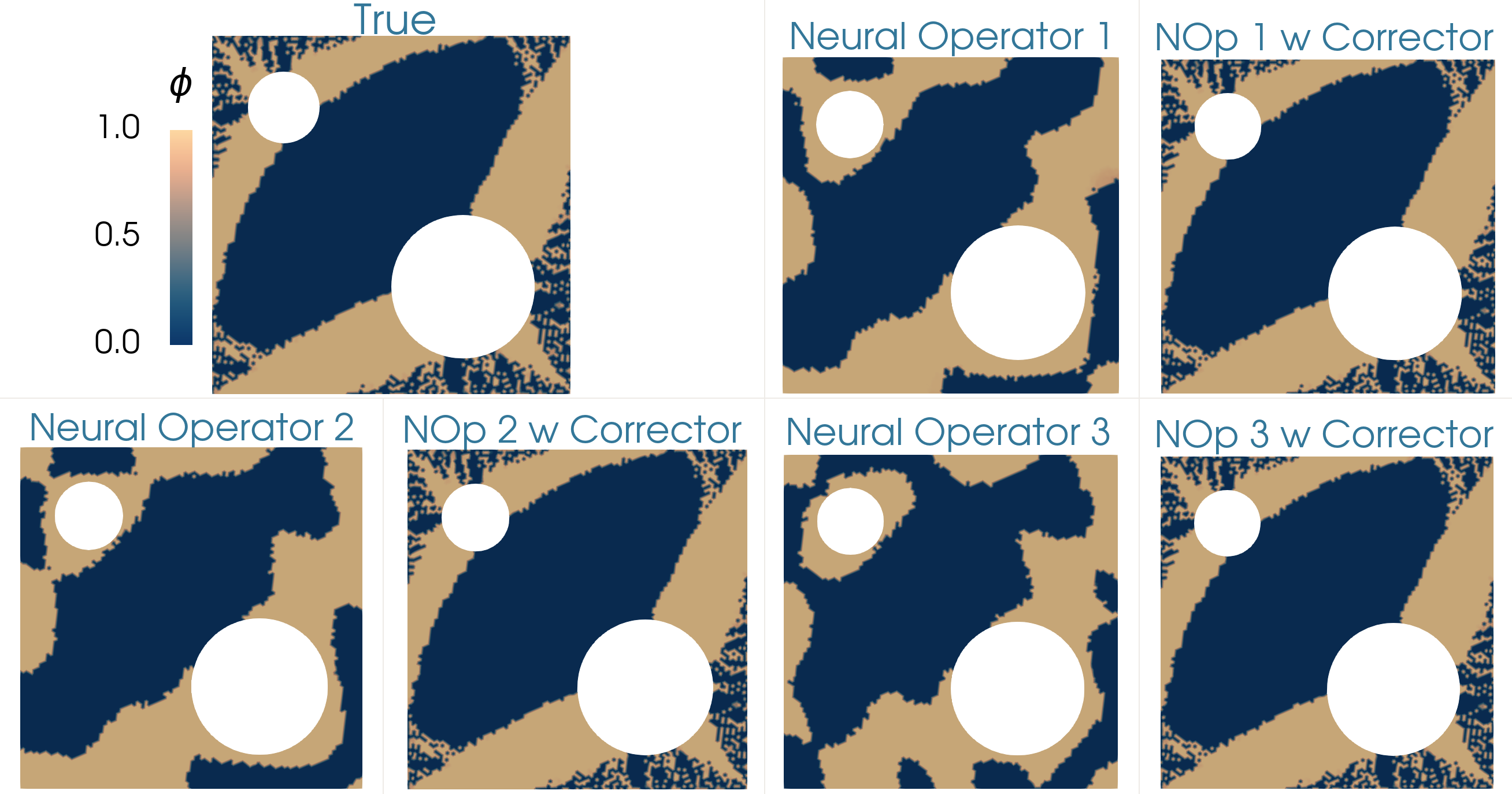
A trained surrogate gives no sign of when it is wrong, and a small average error says nothing about the one input an optimizer is about to query. This paper makes the governing equations themselves the check: substitute the prediction back in, and the residual measures the violation without needing the true answer — then one linear solve corrects it. In topology optimization that moved optimizers from errors as high as ~80% to below 7%, which is the difference between a wrong design and a usable one.
Abstract
This work focuses on developing methods for approximating the solution operators of a class of parametric partial differential equations via neural operators. Neural operators have several challenges, including the issue of generating appropriate training data, cost-accuracy trade-offs, and nontrivial hyperparameter tuning. The unpredictability of the accuracy of neural operators impacts their applications in downstream problems of inference, optimization, and control. A framework based on the linear variational problem that gives the correction to the prediction furnished by neural operators is considered based on earlier work in JCP 486 (2023) 112104. The operator, called Residual-based Error Corrector Operator or simply Corrector Operator, associated with the corrector problem is analyzed further. Numerical results involving a nonlinear reaction–diffusion model in two dimensions with PCANet-type neural operators show almost two orders of increase in the accuracy of approximations when neural operators are corrected using the correction scheme. Further, topology optimization involving a nonlinear reaction–diffusion model is considered to highlight the limitations of neural operators and the efficacy of the correction scheme. Optimizers with neural operator surrogates are seen to make significant errors (as high as 80 percent). However, the errors are much lower (below 7 percent) when neural operators are corrected.