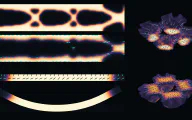
A hard-magnetic soft material (hMSM) is an elastomer carrying permanently
magnetized particles. Put it in a magnetic field and it deforms: the particles
try to rotate into alignment, the matrix resists, and the structure finds a new
equilibrium. It is an attractive way to build something that actuates without a
motor, a tether or a hinge.
The design problem. What makes hMSMs hard to design is that two very
different choices interact. Where you place material sets the structure’s
stiffness; where and how strongly you magnetize sets the load the field applies.
Optimize one with the other fixed and you get a good answer to the wrong
question, because the best magnetization pattern for one geometry is generally
not the best for another.
What the project does about it. Density and magnetization are treated as one
coupled design problem and solved together, under finite-deformation
magneto-elasticity rather than a linearized proxy. Sensitivities come from an
adjoint formulation, so the cost of a gradient does not grow with the number of
design variables, which matters because there are two full fields of them.
Densities are filtered and projected to regularize the design and suppress
mesh-scale features, and the update is by the method of moving asymptotes.
Ian Galloway leads this work and is first author of the resulting manuscript.
Caleb Oien works on the other end of it, building the route from a design the
optimization produces to a printed specimen, which is where a design stops being
a field on a mesh and acquires tolerances. The comparison it rests on is deliberately
unhurried: twenty-one pairings of effective shear-modulus relation and
strain-energy function, compared on the actuation problems themselves, with
experimental stress-strain data then settling which relation goes into the
optimization. A design produced on top of an unexamined material description is
not a design, it is an illustration.
Where it is going. Neural operator surrogates are being introduced to make
the repeated forward solves affordable, which is what the supporting award is for, and also why this project and the
error-controlled surrogates work
are two halves of the same argument rather than separate interests. Phase-field
constraints on the design are a current direction.